

Based on actual industry experience. Certain facts have been generalised to protect the identities of the parties involved.
One afternoon, I received a call from the chairman of a newly elected Joint Management Body (JMB). His first question was simple.
"We've finally won the election... but where do we begin?"
Behind that question was years of frustration. Residents had tried several times to elect a new committee during previous Annual General Meetings (AGMs). Each time, they came close, but the status quo remained. This year, they finally succeeded.
However, after taking over the management office, the new committee quickly realised that winning the election was only the first step. The challenges before them were significant.
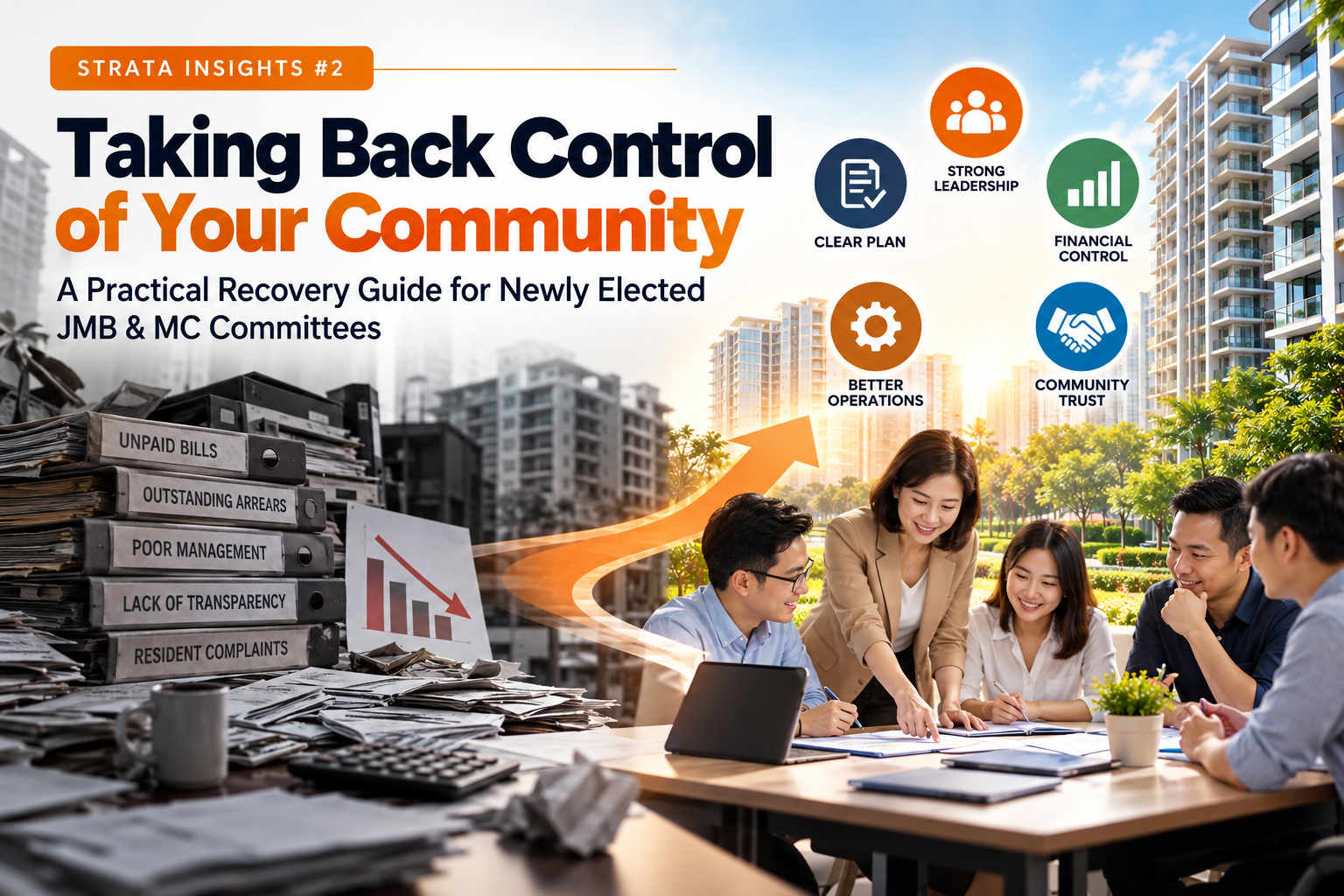
- Outstanding maintenance charges had exceeded RM6 million.
- The operating account was running at a deficit.
- Payments to suppliers and contractors were overdue.
- Maintenance standards had deteriorated.
- Security arrangements no longer inspired confidence.
- Residents had become frustrated and sceptical that meaningful change was even possible.
Like many newly elected committees, they wanted to solve everything immediately. Unfortunately, communities that have declined over many years cannot be transformed overnight.
The first step is not to do everything. It is to do the right things first.
Step One: Regain Control
The committee's first responsibility is to regain proper control of the management of the community.
Over time, some committees become overly dependent on their managing agent. Important information, operational knowledge and even historical records gradually become concentrated in the hands of one service provider.
Eventually, the committee finds itself making decisions based only on the information it is given. This is never healthy governance.
A managing agent is appointed by the committee to provide professional advice and manage day-to-day operations. It should never replace the committee's leadership.
If confidence in the managing agent has broken down, the committee should carefully review the management agreement, obtain professional advice where necessary and ensure that any termination is carried out professionally and in accordance with the contractual requirements.
Changing a managing agent is never an easy decision. However, where trust has been lost, change may be necessary to restore confidence within the community.
Step Two: Own Your Community's Data
One lesson I have learned repeatedly throughout my career is this:
The community should always own its own data.
Many committees only realise the importance of this after deciding to appoint a new managing agent. Suddenly, they discover that their accounting records, resident database and digital systems are all controlled by the outgoing managing agent. The transition becomes unnecessarily complicated.
My advice has always been consistent.
Whatever accounting system or community management platform is selected, the subscriber should always be the JMB or MC—not the managing agent.
- Managing agents may change.
- Committee members may change.
- The community's records should remain with the community.
- Digital systems should strengthen governance, not create dependency.
If the outgoing managing agent is unable or unwilling to provide a proper handover, the committee should document every request and seek guidance from the Commissioner of Buildings (COB). Where residents' personal data is involved, the committee should also consider the appropriate legal and regulatory avenues available to protect that information.
Even in difficult situations, recovery is possible.
With audited financial statements, bank records and supporting documentation, an experienced managing agent can reconstruct financial records and rebuild the community's accounting system.
It requires time and effort—but it can be done.
Step Three: Appoint the Right Managing Agent
Changing a managing agent should never be viewed as simply replacing one company with another. It is an opportunity to reset the way the property is managed.
When evaluating potential managing agents, committees should look beyond management fees.
- Experience matters.
- Professional support matters.
- Strong financial management matters.
A capable managing agent should be able to assist the committee in preparing a realistic recovery plan that covers financial management, maintenance, security, compliance and resident communication.
Most importantly, the managing agent should act as a professional adviser—not merely an administrator.
Step Four: Focus on Recovery, Not Perfection
One mistake I often see newly elected committees make is trying to fix every problem immediately. That rarely works.
Residents naturally expect improvements after electing a new committee. However, it is important to communicate realistic expectations. A property that has been neglected for years requires careful planning and disciplined execution.
- Start with a comprehensive building inspection.
- Identify critical safety issues.
- Prioritise maintenance based on urgency and available funds.
- Review all service contracts.
- Strengthen financial controls.
Most importantly, improve the collection of outstanding maintenance charges. Without healthy cash flow, even the best maintenance plans cannot be implemented.
A professional managing agent should have a structured credit control process that includes regular engagement with defaulters, formal recovery procedures and, where appropriate, legal action.
As collections improve, the committee can gradually enhance maintenance standards, strengthen security measures and rebuild confidence among residents.
Recovery is not measured by how quickly problems disappear. It is measured by whether the community is moving in the right direction.
Communicate the Journey, Not Just the Destination
One mistake newly elected committee often make is trying to show immediate results.
Residents naturally expect change after voting for a new committee. However, when problems have accumulated over many years, meaningful improvements take time.
Rather than promising quick fixes, communicate honestly with residents.
- Explain the current financial position.
- Share the priorities.
- Provide regular progress updates.
When residents understand where the community is today, where it is heading and why certain decisions are necessary, they are far more likely to support the committee throughout the recovery process.
People are generally willing to be patient—as long as they know progress is being made.
After all:
- Transparency builds confidence.
- Consistency builds credibility.
- Trust builds stronger communities.
From My Experience
Throughout my years working with developers, property managers and strata communities, I have seen properties recover from situations that once appeared impossible.
What made the difference was not newer facilities or larger budgets. It was leadership.
Successful committees do not promise miracles.
- They provide direction.
- They listen to professional advice.
- They communicate honestly with residents.
Most importantly, they understand that every decision should serve the long-term interests of the community.
One lesson has remained with me throughout my career.
A managing agent should never become more powerful than the committee it serves.
The committee is elected by the residents.
The managing agent is appointed by the committee.
When that relationship remains clear, the community remains in control of its own future.
And that is where lasting good governance begins.
Quick Takeaways
- Regain control before trying to solve every problem.
- Ensure the JMB or MC owns its accounting system and community data.
- Choose a managing agent based on competence, not familiarity.
- Develop a structured recovery plan instead of seeking quick fixes.
- Keep residents informed throughout the recovery journey.
- Good governance is built on leadership, transparency and accountability.