

One question follows me almost everywhere I go.
Whether I am conducting committee training, visiting a property or advising a newly elected JMB or MC, someone will eventually ask,
"Can we do this?"
The questions may be different, but they usually sound something like this:
- Can we impose a RM500 fine on residents who repeatedly breach the House Rules?
- Can we charge administrative fees for renovation applications or facility bookings?
- Can we prevent defaulters from using the boom gate?
- Can we restrict visitors from entering if the owner has outstanding maintenance charges?
- Can we restrict Airbnb or short-term rental activities?
- Can we disconnect the water supply of persistent defaulters?
- Can we upgrade our access control system without obtaining approval at an AGM or EGM?
These are genuine concerns faced by committees every day.
Many committee members simply want to protect their community, improve security and encourage residents to comply with the rules.
However, before asking "Can we do this?", there is another question every committee should ask first.
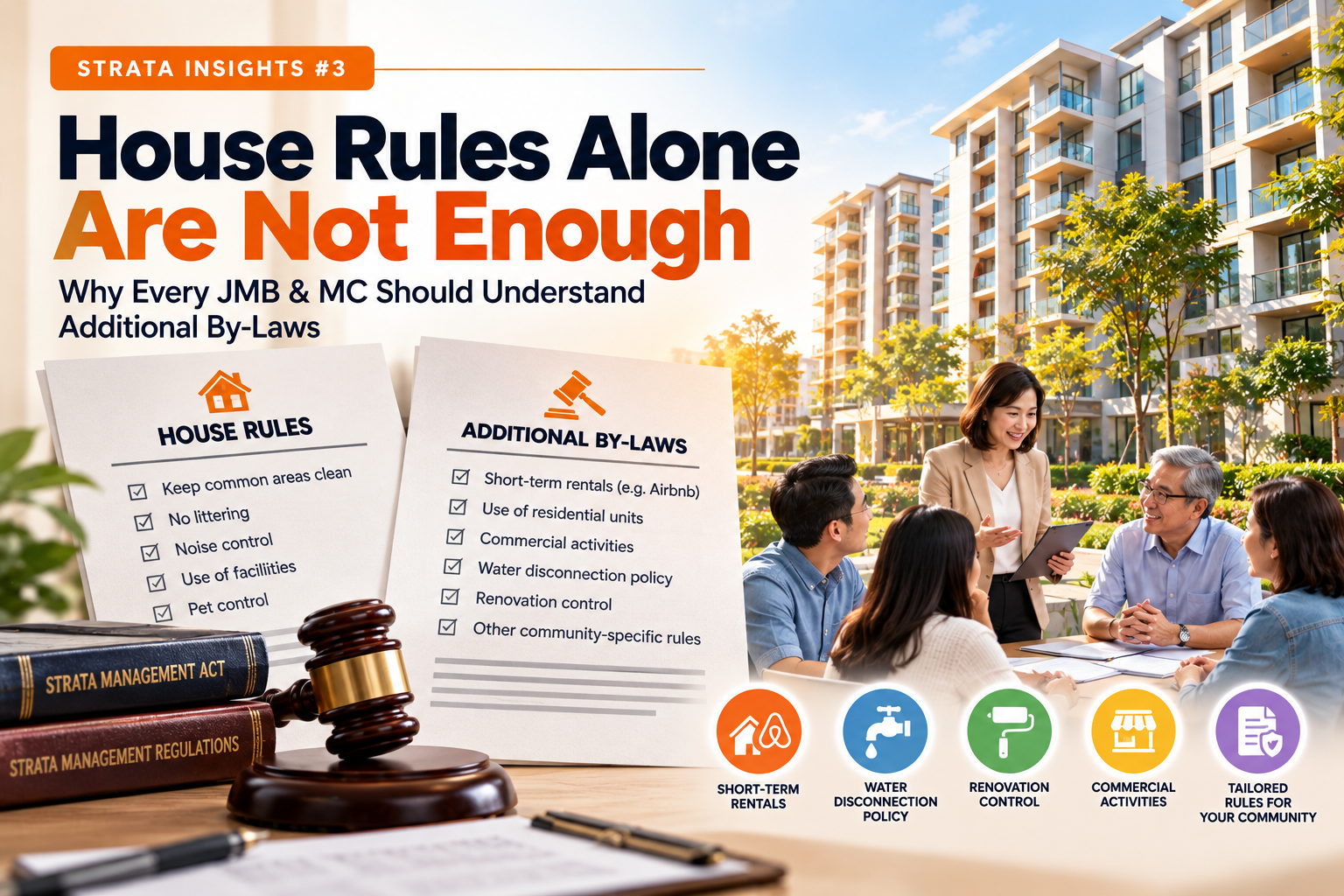
"Do we have the authority to do this?"That simple question often leads us to one of the most misunderstood aspects of strata management—Additional By-Laws.
Why Are Additional By-Laws So Important?
Throughout my years working with JMBs and MCs, I have noticed that many committees inherit a set of House Rules from the developer and simply continue using them without giving them much thought.
Some communities still refer to the Deed of Mutual Covenant (DMC), while others make amendments to the existing House Rules whenever new issues arise.
The assumption is simple:
"We already have House Rules, so everything is covered."
Unfortunately, it is not always that straightforward.
When disputes arise or enforcement becomes necessary, committees sometimes discover that relying solely on inherited House Rules may not provide the governance framework they expected.
This is why Additional By-Laws are so important.
Understanding the Difference
Before the formation of the JMB, purchasers normally sign a Deed of Mutual Covenant (DMC) with the developer.
The DMC governs the rights and responsibilities of purchasers during the developer's management period.
Many developers also introduce House Rules to regulate daily living within the community.
Once the JMB or MC takes over the management of the property, the governance of the development falls under the Strata Management Act 2013 (SMA) and the Strata Management Regulations 2015 (SMR).
Rather than simply continuing with the existing House Rules, committees should review them carefully.
If certain rules are important for the long-term management of the community, they should consider adopting them properly as Additional By-Laws through an AGM or EGM in accordance with the requirements of the Strata Management Act.
Doing so provides greater clarity for both the committee and residents while strengthening the governance framework of the community.
Additional By-Laws Are Not About Giving Committees More Power
This is another common misconception.
Some residents worry that Additional By-Laws allow committees to create whatever rules they like.
That is not the purpose.
Additional By-Laws exist to provide clarity and consistency.
They clearly communicate what is expected of residents and provide the committee with a stronger governance framework when managing the community.
Most importantly, they ensure that everyone is subject to the same rules that have been properly considered and approved by the community.
That benefits everyone—not just the committee.
Not Everything Can Be Made Into an Additional By-Law
This is equally important.
While Additional By-Laws are an important governance tool, they are not unlimited powers.
They cannot override the Strata Management Act, the Strata Management Regulations or any other applicable legislation.
This is why there is often no simple "yes" or "no" answer to questions involving Airbnb, water supply disconnection, access restrictions or certain penalties.
Some matters involve other legislation, court decisions or legal principles beyond the Strata Management Act.
Additional By-Laws should therefore be viewed as part of the governance framework—not as a solution to every management issue.
Whenever there is uncertainty, committees should seek professional advice before introducing new restrictions or enforcement measures.
Prevention Is Better Than Dispute
One of the biggest mistakes I see is that committees only start asking about Additional By-Laws after someone has challenged their authority.
By then, the disagreement has already begun.
A much better approach is to review the existing House Rules early.
Ask yourself:
- Are these rules still relevant?
- Are they consistent with the current law?
- Should some of them be formally adopted as Additional By-Laws?
A few hours spent reviewing your governance framework today may prevent years of unnecessary disputes tomorrow.
From My Experience
Over the years, I have come to realise that good governance is not measured by how many rules a community has.
It is measured by whether those rules are fair, transparent and properly adopted.
I have met many hardworking committee members who genuinely wanted to improve their communities. Unfortunately, some only discovered the importance of Additional By-Laws after a dispute had already arisen.
My advice is always simple.
Don't wait until someone challenges your authority.
Review your House Rules.
Understand the purpose of Additional By-Laws.
Seek professional advice whenever necessary.
Good governance is not about making more rules.
It is about ensuring that the rules which matter are properly adopted, clearly understood and fairly enforced for the benefit of everyone in the community.
Quick Takeaways
- Understand the difference between the DMC, House Rules and Additional By-Laws.
- House Rules alone may not always provide the governance framework your community requires.
- Additional By-Laws help strengthen clarity, consistency and governance.
- Additional By-Laws cannot override the Strata Management Act or other applicable laws.
- Review your governance framework before disputes arise—not afterwards.
- Strong communities are built on transparency, fairness and good governance.